
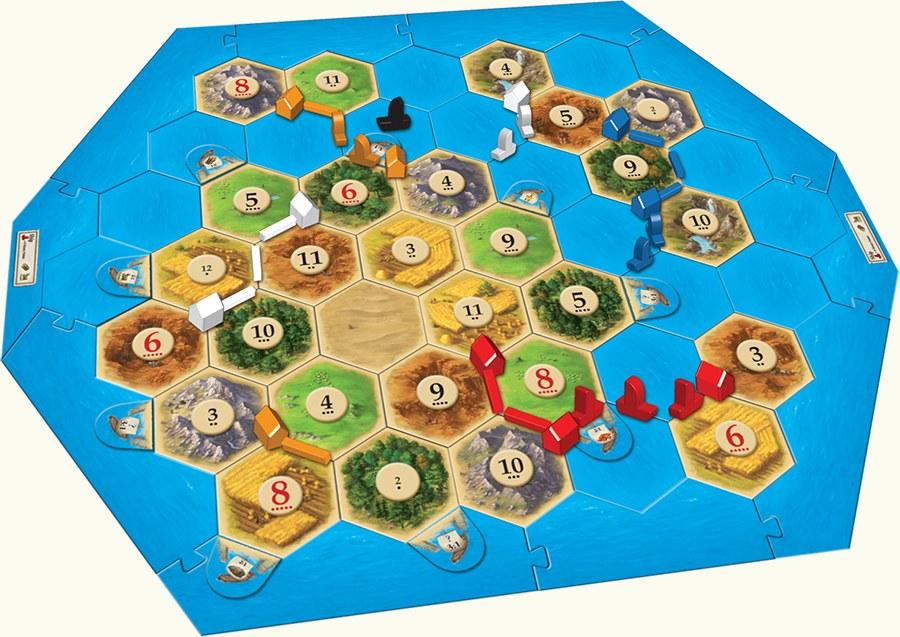
What is Seafarers?
The first and simplest Catan expansion — set sail for new islands
⛵ The Big Idea
Seafarers expands Catan from one island to multiple islands separated by ocean. You build ships to cross the sea, discover new lands, and settle new territory. Earn bonus victory points for being the first to settle a new island.
🎯 Quick Facts
Players: 3–4 (5–6 with extension) | Time: 90–120 min | VP to win: Varies by scenario (usually 12–14)
Requires: Catan base game | Difficulty: Easy to learn if you know the base game
🆕 What Seafarers Adds
📋 What Stays the Same
All base game rules still apply — dice rolling, resource production, trading (domestic and maritime), the robber, development cards, Longest Road (now called Longest Trade Route), Largest Army, and the Distance Rule. Seafarers only adds new mechanics on top of the base game.
What's New in Seafarers
Everything that changes from the base game
🗺️ The Board
Instead of one compact island, Seafarers uses a larger board with multiple islands separated by sea hexes. The board layout changes depending on which of the 9 scenarios you choose. The frame is bigger (uses both base game and expansion frame pieces), and harbors are placed randomly from tokens.
🛤️ Longest Road → Longest Trade Route
"Longest Road" is renamed Longest Trade Route in Seafarers. Ships and roads both count toward it, as long as they form a continuous connected path through your settlements/cities. A route can be a mix of roads on land and ships on sea, connected through a shared settlement or city.
🏠 Starting Placement
During setup, if you place a starting settlement on the coast, you may place a ship instead of a road next to it. This lets you head to sea immediately instead of expanding on land first.
⭐ Settling New Islands
In most scenarios, when you build your first settlement on a new island (one you didn't start on), you earn special victory point token(s) — typically 1 or 2 VP depending on the scenario. This bonus stays with you for the rest of the game. Place the VP chit under the settlement that earned it so all players can see.
Ships
Your roads across the ocean
⛵ Building Ships
Ships are placed on edges between two sea hexes or between a sea hex and a land hex (coastal edge). Ships cannot be placed between two land hexes. A ship must connect to one of your existing settlements, cities, or ships — not roads. Ships and roads can only connect through a settlement or city at their shared intersection.
🔄 Moving Ships
Unlike roads, ships can be moved. Once per turn, you may move the last ship in an open shipping route to any other legal position connected to your network.
Open route: A shipping route where one end does not connect to a settlement or city. Ships in open routes can be moved.
Closed route: A shipping route connecting two settlements/cities on both ends. Ships in a closed route are locked and cannot be moved.
🛤️ Shipping Routes & Trade Routes
A shipping route is a continuous line of connected ships. A trade route is a continuous path of roads AND ships connected through settlements/cities. Your trade route counts toward the Longest Trade Route card (2 VP), replacing Longest Road from the base game.
The Pirate
The robber of the seas
☠️ How the Pirate Works
The pirate starts off the board (not on any hex). When you roll a 7 or play a Knight card, you now have a choice:
You must choose one — you cannot move both.
🚫 What the Pirate Blocks
While the pirate sits on a sea hex:
• No ships can be built on any edge of that hex
• No ships can be moved away from that hex
• The pirate does NOT block settlements, cities, or roads from being built
• The pirate does NOT block harbor trades
💰 Stealing with the Pirate
After placing the pirate, you must steal 1 random resource card from any player who has a ship on the edge of that sea hex. If multiple players have ships there, you choose which one to steal from. Development cards cannot be stolen.
Gold Hexes & Fog Tiles
New terrain types in Seafarers
✨ Gold Hex Tiles
Gold hexes have a number token like normal terrain. When that number is rolled:
• Each settlement adjacent to the gold hex → choose any 1 resource you want
• Each city adjacent to the gold hex → choose any 2 resources you want (can be different)
🌫️ Fog Tiles (Exploration Scenarios)
Some scenarios include face-down hex tiles. You discover what's underneath when you build a ship or road that reaches the fog tile's edge. Flip the tile to reveal either:
• A land hex — place a number token on it; it now produces resources
• A sea hex — open water, keep exploring
When you reveal a land tile, you receive 1 free resource of that terrain type as a discovery bonus.
Building Costs
Same as base game plus ships
⛵ Ship (NEW)
Place on an edge between two sea hexes or between a sea and land hex. Must connect to your settlement, city, or another ship (not a road). Can be moved once per turn if in an open route. Max 15 ships per player.
🛤️ Road
Same as base game. Land edges only.
🏠 Settlement
Same as base game. Must follow Distance Rule. First settlement on a new island earns a bonus VP in most scenarios.
🏙️ City (Upgrade)
Same as base game. Upgrade an existing settlement. Worth 2 VP, produces 2 resources per adjacent hex.
🃏 Development Card
Same as base game. The Road Building card now lets you place 2 roads, 2 ships, or 1 of each.
The 9 Scenarios
Each scenario is a different island layout with unique rules and victory conditions
1. Heading for New Shores
The introductory scenario. Two smaller islands near the main island. Build ships to reach them and settle first for bonus VP.
2. The Four Islands
Four separate islands of roughly equal size. Each player starts on one island and must expand to others via ships.
3. The Fog Islands
Introduces fog tiles — face-down hexes that are revealed as you explore by building ships toward them. Discover land or sea.
4. Through the Desert
A large desert separates the main island from outlying islands. Build around the desert or across the sea to expand.
5. The Forgotten Tribe
Discover a native tribe on a remote island. Connect your shipping route to their settlements to earn special rewards and VP.
6. Cloth for Catan
Build trade routes to the Forgotten Tribe's villages. When their numbers are rolled, earn cloth tokens worth VP in pairs.
7. The Pirate Islands
The pirate has a fixed movement path and attacks nearby settlements. Build warships (using Knight cards on ships) to defend.
8. The Wonders of Catan
Race to build Wonders — massive structures with high resource costs. Each Wonder is unique with special requirements and VP.
9. New World
The entire board is fog tiles — completely unknown. Total exploration. Every hex is a surprise. Most replayable scenario.
📋 Scenario Tips
Start with Scenario 1 (Heading for New Shores) if you're new to Seafarers — it teaches ships and settling new islands without any complex rules.
Scenarios 3 and 9 (Fog Islands, New World) are the most replayable because the board is different every time.
Scenario 7 (Pirate Islands) changes how the pirate works and adds combat — play this after you're comfortable with the basics.
Strategy Tips
How to win at Seafarers
🐑 Wool and Lumber Are King
Ships cost wool + lumber, and you'll build a lot of them. Prioritize starting settlements near pastures and forests. Brick and ore are less important early on compared to the base game.
🏝️ Rush New Islands Early
The bonus VP for being the first to settle a new island is free points. Getting to new islands early also gives you access to resources that other players can't reach yet. Don't wait — build ships immediately.
✨ Gold Hexes Are Traps (Sometimes)
Gold hexes are powerful but usually have low-probability numbers (2, 3, 11, 12). A settlement on a regular 6 or 8 hex will produce more often. Only go for gold if it has a decent number or you need the flexibility.
☠️ Use the Pirate Strategically
The pirate blocks ship building AND movement on its hex. Place it on a sea hex where your opponent is trying to expand toward a new island. This is often more devastating than the robber, especially in the early game when sea routes are critical.
🔄 Move Ships, Don't Waste Them
Remember: you can move 1 open-ended ship per turn for free. If a route isn't working out, redirect your last ship rather than building a new one. Keep routes open (don't connect both ends) until you're sure of your path.
🛤️ Longest Trade Route is Easier
With both roads and ships counting, building a long continuous route is more achievable than in the base game. Combine land roads + sea ships through a coastal settlement for a massive trade route.
📘 Official Rules Reference
This guide covers the Seafarers expansion rules and all 9 scenarios based on the official rulebook. For the complete official rules, including errata and tournament-specific rulings, download the PDF from the publisher: